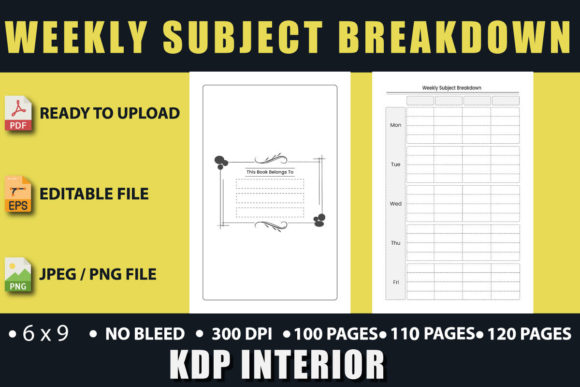
Weekly Subject Breakdown: KDP Interior Design
Launching a successful low-content publishing business on Amazon requires more than just a niche idea; it demands professional execution. The Weekly Subject Breakdown interior template addresses one of the most common hurdles for new publishers: creating a structured, functional layout that actually helps the end user. This isn't merely a collection of blank lines. It is a pre-designed system optimized for the 6x9 inch trim size, specifically engineered to guide users through organizing their weekly topics, study sessions, or project milestones. For entrepreneurs and content creators looking to expand their digital asset portfolio, this template offers a balance of immediate usability and long-term customization potential.
The visual personality of this interior leans toward clean utility and modern organization. In the realm of editorial design for journals, clutter is the enemy of engagement. This layout utilizes ample whitespace and clear typographic hierarchy to ensure the user never feels overwhelmed. The structure supports cognitive processing by breaking down complex weeks into manageable subjects. Whether used for academic planning, content scheduling, or personal development tracking, the design maintains a professional aesthetic that elevates the perceived value of the final printed book. It avoids the generic feel of mass-produced notebooks, offering instead a purposeful tool that resonates with adults seeking structure in their daily routines.
Strategic Applications Across Niches
Versatility is a key metric when evaluating design assets for commercial use. While the name suggests an academic focus, the Weekly Subject Breakdown framework adapts seamlessly to various markets. Content creators and social media managers often repurpose this layout as a content batching journal, where "subjects" become platform-specific tasks like Reels, Blog Posts, or Email Newsletters. Marketers may use it for campaign tracking, breaking down weekly objectives across different channels. For students and lifelong learners, it serves as an effective revision timetable or skill acquisition tracker.
This adaptability extends to physical product creation beyond KDP. Crafters and small business owners who sell digital planners or printable stationery can utilize the included editable AI files to create cohesive brand identity systems. The layout works exceptionally well for:
- Educational Planners: Helping students organize coursework by subject rather than just time.
- Professional Development Journals: Tracking skill-building activities alongside daily work tasks.
- Creative Project Management: Breaking down large artistic endeavors into weekly thematic focuses.
- Habit Trackers: Where each "subject" represents a specific habit or wellness goal.
By positioning this interior as a multi-functional organizational tool rather than a simple notebook, publishers can target broader keywords and appeal to diverse audience segments without altering the core file structure.
Technical Specifications and Print Readiness
One of the most significant friction points in self-publishing is formatting errors. A rejected file delays revenue and damages seller metrics. The Weekly Subject Breakdown package mitigates this risk through rigorous pre-testing on KDP’s submission platform. The 6x9 inch dimension is the industry standard for portable journals, striking an ideal balance between writing space and shelf presence. With options for 100, 110, or 120 pages, publishers can adjust the price point and spine width to match market expectations for premium stationery.
The "No Bleed" specification is a deliberate choice for this type of interior. Keeping all content within the safe margin ensures that no critical lines or headers are trimmed during the binding process. This is particularly important for functional layouts where a cut-off line renders a page useless. The high-quality print-ready PDF guarantees crisp text and sharp lines, avoiding the grayish, pixelated output that plagues amateur interiors. When customers receive a book with professional modern typography and precise alignment, positive reviews follow naturally. Trust in the physical product translates directly to trust in the publisher's brand.
Customization and Brand Differentiation
In a saturated marketplace, uniqueness drives sales. While the ready-to-upload PDF allows for immediate launch, the true value lies in the editable Adobe Illustrator (AI) and JPEG source files. These assets empower designers to move beyond template dependency. You can modify header fonts to match a specific handwritten font or serif font style that aligns with your cover design. Adding custom logos, changing color accents from black to a branded hue, or adjusting column widths transforms a generic template into proprietary intellectual property.
Effective font pairing is essential when customizing these interiors. If your cover features a bold display font, consider using a complementary sans serif font for the interior headers to maintain readability while echoing the cover’s energy. Conversely, if the cover uses a delicate script font, a clean geometric sans serif inside prevents visual fatigue. The editable files allow you to test these combinations before committing to print. This level of control ensures consistency across your catalog, helping customers recognize your books instantly. Building a recognizable series based on consistent interior styling is a proven strategy for increasing customer lifetime value.
Evaluating Fit and User Experience
Before uploading any interior, experienced publishers evaluate the user experience (UX) of the printed page. Does the Weekly Subject Breakdown provide enough writing space? Is the gutter margin sufficient for a 120-page book so users don't have to break the spine to write near the center? This template has been designed with these physical constraints in mind. However, testing remains crucial. Order a proof copy and use it yourself for a week. Write in it with different pens. Check if the paper weight (standard 55# or 60# cream/white) interacts well with the ink density of the layout.
Consider your target audience’s specific needs regarding readability. Older demographics may require larger body text and higher contrast, while minimalist enthusiasts might prefer lighter weights and more negative space. The ability to edit the AI file means you can create multiple variations from a single master asset. Perhaps one version targets university students with dense tracking grids, while another targets busy parents with simplified weekly overviews. This segmentation approach maximizes the ROI of your initial design investment.
Licensing and Commercial Viability
Understanding usage rights is non-negotiable for commercial publishers. This asset package typically includes commercial licensing for KDP and print-on-demand platforms, but always verify the specific terms included with your download. Ensure you are permitted to modify the files and claim the resulting derivative work as your own. Never upload the unmodified PDF to multiple accounts or share the source files publicly. Protecting your intellectual property starts with respecting the original creator’s license.
For marketers and bloggers integrating this into a larger ecosystem, consider how this journal complements existing digital products. A course creator might bundle this physical journal with an online curriculum, using the Weekly Subject Breakdown as the tactile companion to video lessons. This cross-pollination enhances the perceived value of both offerings. The inclusion of JPEG files further expands utility, allowing you to showcase interior spreads in social media graphics, Amazon A+ Content, or blog posts without needing to photograph a physical mockup. High-resolution previews build confidence in potential buyers who want to see exactly what they are purchasing.
Ultimately, the Weekly Subject Breakdown serves as a foundational element for a sustainable publishing business. It removes technical barriers while providing a canvas for creative expression. By focusing on user utility, maintaining high production standards, and leveraging customization options, publishers can transform a simple template into a distinctive brand asset. Success in KDP isn't about finding a magic keyword; it's about delivering genuine value through thoughtful design and consistent quality. This interior template provides the structural integrity needed to support that mission, allowing you to focus on marketing, audience building, and scaling your creative enterprise.